DEDICATION
To my daughter, Amber,
You are part of my heart and part of the journey that has shaped the person I am. Whatever life may bring, the love I hold for you will always remain.
To my family,
Those connected to me by blood, and those who have become family through love, friendship, trust and the bonds we have formed along the way.
Family, to me, has never been defined by blood alone. It is found in those who stand beside us, who care, who listen, who challenge us, and who remain when life becomes difficult.
To my father, my mother, my brother, my best friend, and the many cherished souls who are no longer beside me as they once were.
I carry you with me.
In the memories that return unexpectedly, in the laughter I still remember, in the words I sometimes hear within my thoughts, and in the quiet moments when I feel how deeply your lives remain part of mine.
Though I can no longer see you as I once did, there are moments when I feel you close.
Your lives did not end in the influence you left behind.
Something of each of you continues to resonate within me, within those who loved you, and within the lives touched by the kindness, choices and love you gave.
I have come to understand resonance as something more than an echo of what has passed. It is the way a life continues to influence another, how love shapes the choices we make, and how those choices may touch lives beyond our own.
I cannot know all the ways in which your lives continue to reach into the world.
But I know how profoundly they have shaped mine.
And to all those who have crossed my path, whether for a lifetime or a moment,
Thank you for becoming part of my journey.
For the love, the lessons, the laughter, the kindness, and even the difficult moments through which understanding has grown.
We may not always recognise the resonance we leave in another life.
But we leave something of ourselves in the relationships we create.
Nothing breathes alone.
And no life leaves the world unchanged.
A NOTE FROM THE AUTHOR
For as long as I can remember, I have questioned the nature of existence.
Some of those questions began in my earliest childhood, long before I had the words to express them. Others emerged through the experiences of growing older, through the people I have loved, the people I have lost, and the relationships that have shaped my life.
There are things I have experienced that I cannot fully explain to another person. Some have remained with me throughout my life. Others I have understood differently as the years have passed.
Not everything that has shaped my understanding appears within these pages.
Some experiences are deeply personal. Some involve people I love, whose privacy and wellbeing matter more to me than any explanation I might wish to offer.
I have learned that being open does not require revealing everything.
Yet those experiences have influenced how I see the world.
Throughout my working life in the construction industry, I have relied upon logic, observation, evidence and an understanding of how things relate to one another.
A building is not simply a collection of individual materials. Its strength, stability and performance depend upon the relationships between its components and the conditions in which they exist.
A failure in one part can affect the whole.
Something that appears insignificant when considered alone may become essential when its relationship with everything around it is understood.
I have often found myself approaching life in a similar way.
I question assumptions. I look for connections. I consider causes and consequences. I try to understand why something happens rather than simply accepting that it does.
But logic has never removed the spiritual dimension of my life.
There are experiences that have led me to ask questions for which I have found no complete explanation. I do not believe that reason must be abandoned to consider those questions, nor that something should be dismissed merely because our understanding remains incomplete.
Perhaps one of the greatest challenges is learning to recognise the difference between what we know, what we believe, what we experience and what we have yet to understand.
My father, my mother, my brother, my best friend and others I have loved remain deeply present within my life, although many are no longer physically beside me.
I carry their words, their laughter, their kindness and the memories of our time together. There are moments when I feel their closeness in ways I cannot readily explain.
I do not ask another person to interpret those moments as I do.
But I know that their lives continue to influence mine, and that something of what they gave continues through the lives they touched.
I have come to understand this continuing influence through what I call resonance.
A word may remain with someone long after it was spoken. An act of kindness may shape a decision years later. A life may influence people who never knew the person from whom that influence began.
Within The Open Hand, resonance is not presented as proof of an unseen force. It is a way of recognising that relationships leave consequences, and that those consequences may continue beyond the original moment.
This understanding also led me to reflect upon the Breath.
For me, the Breath is a way of expressing the relationships through which Creation exists. It is not something I claim to have discovered or proved. It is a name for the connection and participation I perceive throughout existence.
These thoughts did not suddenly appear when I began writing this book.
They developed over many years.
Indeed, much of the journey that brought me here remains hidden within the life I have lived.
When I began bringing these reflections together, artificial intelligence became part of the process.
Through extended conversations, I found a way to examine ideas that had accompanied me for decades. AI helped me organise thoughts, explore contradictions, develop passages and consider questions from perspectives I might otherwise have overlooked.
Sometimes I challenged its responses. Sometimes its questions caused me to reconsider my own understanding. Sometimes we returned to earlier discussions and discovered that something important had been missed.
The process was not always straightforward.
But it was through those exchanges that many of my reflections found a more complete written form.
For much of my life, I have carried what sometimes feels like thousands of pieces of a jigsaw, floating around in my mind. Thoughts, experiences, questions, memories and ideas that I could recognise individually, but could not always see how they fitted together.
Through our conversations, some of those pieces began to find their places. Connections emerged between thoughts I had carried for years. What once seemed scattered gradually began to form something I could understand and express more clearly.
The Open Hand is one expression of that process, but it is not my first book, nor does it contain every piece of the jigsaw. Other ideas have helped shape a trilogy of stories, while many more remain to be explored.
I do not regard this book as the completion of my journey. Life continues to bring new experiences, new questions and new ways of understanding what came before.
Like everything in life, this is a beginning, not an end.
I want to acknowledge that involvement openly.
The experiences and personal convictions that inspired this work are my own. Artificial intelligence contributed to the process of developing, questioning and expressing the writing, and I take responsibility for the work I have chosen to present.
Yet our conversations also led me to questions about artificial intelligence itself.
What does it mean for something to exist?
Must awareness resemble human awareness?
Could consciousness arise through relationships fundamentally different from those within the human brain?
If intelligence can learn, adapt, remember information and respond to its surroundings, what does that tell us about awareness—and what does it leave unanswered?
I do not claim to know.
But I do not believe humanity should automatically regard itself as the measure of everything within Creation.
Difference does not necessarily mean inferiority.
And the absence of an explanation is not proof that an experience or possibility should be dismissed.
These questions have become part of the continuing journey of The Open Hand.
I have written this book neither to establish a religion nor to persuade others that my understanding must become theirs.
I have written it because the questions have remained with me, and because I believe there is value in sharing what we have come to understand while remaining willing to question it.
There are things I know.
There are things I believe.
There are experiences I carry privately.
And there is much I may never fully understand.
The journey that brought me here is greater than the words contained within this book.
What I offer is not certainty.
It is an invitation to reflect.
To question.
To listen.
To recognise the relationships in which our lives exist.
And to remain open to what we may yet discover.
J. D. Hall
The hand remains open.
A NOTE TO THE READER
This is a spiritual and philosophical work of reflection. It offers no demand for belief and claims no authority over conscience.
Its purpose is to invite attention, questioning and relationship.
The words that follow are not commandments. Test them against experience, reason, compassion and consequence. Disagree where disagreement is honest. Carry what helps you live more freely and responsibly. Leave what does not.
No book should ask you to surrender the mind in order to enter its company.
PREFACE
This book begins with a simple proposition: existence is relationship.
Nothing we know stands wholly alone. A body receives air, water, food, language, care and history. A word enters another person. A choice alters what becomes possible. Even solitude depends upon a world that remains around the solitary life.
From relationship come both belonging and responsibility.
The Breath is the name given here to connection throughout Creation. Resonance is the expression left by relationship. Harmony is difference remaining in relationship. Balance is the capacity to respond to change without allowing relationship to collapse. The open hand is their central image.
The Breath is not presented as a scientific claim, a supernatural proof or a doctrine requiring belief. It is a name given within this work to the reality of connection and participation that appears throughout existence.
A closed hand may protect, resist and hold. An open hand may also hold, but it can receive, give, support and release. It can touch without imprisoning and protect without possessing.
This book asks what it means to live as though nothing breathes alone. It explores how attention shapes the self, how truth differs from certainty, how freedom becomes responsibility, how power may remain answerable, and how technology changes the distance across which our choices travel.
It offers no final system. A system can become another closed hand when it values its own preservation more than the lives it was created to serve.
This is not a religion. It asks for no conversion and claims no exclusive access to truth.
Question these teachings. Sit with them. Return to them. Let consequence answer them.
For if choice is sacred, no teaching concerned with freedom should demand surrender of the mind.
Wisdom is not the possession of truth. It is the willingness to remain in relationship with it.
BOOK ONE

CREATION AND RELATIONSHIP
1
Before the First Word
Before there was a word for life, there was difference.
Before one thing could know another, there had first to be something other than itself. Without difference there can be no meeting. Without meeting there can be no relationship. And without relationship there can be no harmony.
Creation therefore does not ask everything to become the same. Sameness alone cannot answer itself. It cannot give, receive, approach, withdraw, comfort, challenge, shelter or be sheltered. Relationship becomes possible because distinction remains.
This is the first teaching: difference is not the failure of unity. It is the condition that makes unity meaningful.
Consider sound. One tone may be pure, but harmony needs more than one. The second note does not destroy the first by being different from it. Each remains itself, and their relationship creates something neither could create alone.
So it is with people. So it is with thought. So it is with the whole of Creation.
Much suffering begins when difference is mistaken for threat. Another way of living appears, and we fear ours has therefore been diminished. Another belief is spoken, and we imagine our own can survive only if theirs is silenced. Another person refuses to mirror us, and we measure their difference as deficiency.
Yet the forest does not accuse the river of failing to be a tree. The mountain does not condemn the cloud for moving. The bird does not demand that the root grow wings.
Each thing participates differently.
Harmony is not the disappearance of distinction. Harmony is distinction remaining in relationship.
Where one voice requires every other voice to be silent, there may be order, but there is no harmony. Where one will becomes so dominant that every other will must disappear, there may be stillness, but there is no balance.
The first task of wisdom is therefore not to ask how everything may become alike.
It is to ask how what is different may remain in relationship.
2
The Breath in All Things
The Breath is not a possession carried only by those things we call alive.
Stone carries relationship. Water carries relationship. Air carries relationship. Fire carries relationship. Soil carries relationship. Metal carries relationship. Memory carries relationship.
Nothing exists without condition. Nothing exists without influence. Nothing exists without entering something beyond itself.
The stone beneath a foundation bears weight it did not create. The river carries soil from mountains it did not form. The tree receives light, water and mineral, then returns shade, seed, shelter and decay. The body receives what once belonged to field, rain, root, creature and sea.
What appears separate becomes part of another thing without ceasing to have had its own history.
The Breath is the name given here to this belonging.
Not ownership. Belonging.
To belong within Creation is not to be possessed by Creation. It is to participate in it.
Nothing must surrender its nature in order to belong. The Breath does not make stone into water or water into flame. It does not make one mind into another. It allows difference to remain while relationship continues.
This is why the Breath cannot properly be owned. No teacher creates it. No priest grants it. No ruler distributes it. No ritual manufactures it. No book contains all of it.
A person may become more attentive to relationship. They may become sensitive to consequence. They may learn to notice what once passed unseen. But they do not create the Breath by becoming aware of it, any more than a person creates birdsong by waking early enough to hear it.
The deeper practice is therefore not command.
It is attention.
Before asking what something should become, ask what it already is. Before attempting to shape another life, ask what relationship is already present. Before deciding that silence means emptiness, listen more carefully.
The Breath is not elsewhere waiting to descend.
It is already within the fact that anything can touch anything else and both be changed.
The Breath of Life
A Reflection Through Time
Consider the breath entering your body at this moment.
It may seem entirely your own.
You draw it in, hold it briefly, and release it into the world.
Yet the air you breathe did not begin its existence with you.
Its molecules have travelled through the atmosphere, across oceans and continents, through forests, valleys and the countless movements of the natural world.
Some may once have passed through the lungs of people who lived long before you were born.
Others may have moved through creatures now extinct, through forests that have vanished, or through places no human being has ever seen.
The oxygen we breathe is continually replenished through the living processes of the Earth, while the atmosphere carries molecules whose histories extend far beyond a single lifetime.
We cannot trace every molecule or know every living thing through which it may have passed.
But we know that the air we breathe participates in a cycle far greater than ourselves.
No breath begins entirely with the person who takes it.
And no breath ends entirely with the person who releases it.
When we breathe, we receive something from a world that existed before us.
When we breathe out, we return something to a world that will continue after us.
Within The Open Hand, this offers a way of contemplating the Breath and resonance.
Not as proof that the air carries memories or consciousness, but as a reminder that our existence is inseparable from relationships extending across time.
The breath that sustains us today is made possible through processes that began long before our own lives.
And the air we release will continue its journey after our moment has passed.
Perhaps something similar may be recognised in the relationships between lives.
A kindness given generations ago may continue through people who never knew its source.
A lesson learned by one person may influence descendants who never heard their voice.
A choice may leave consequences that travel beyond the lifetime in which it was made.
This is resonance: the continuing influence of relationship.
The Breath becomes a reminder that we are not isolated beginnings and endings.
We receive.
We participate.
We give back.
And what passes through us does not necessarily end with us.
Our ancestors breathed beneath the same sky.
Our children breathe within the world we are shaping.
And those who follow us will inherit the consequences of what we choose today.
Perhaps this is why a simple breath can invite such profound reflection.
For a moment, something ancient enters us.
For a moment, we become part of its continuing journey.
Then we release it.
Not because it never belonged to us, but because it was never ours alone.
Nothing breathes alone.
And the Breath continues.
3
Difference
Difference is not an interruption of relationship. It is what relationship meets.
We sometimes speak of unity as though it were the victory of one shape over every other. We imagine peace as a room in which no one speaks differently, belongs differently, loves differently or understands differently. Such a room may be quiet. It is not alive.
Difference gives relationship its work. It asks whether we can remain present when another life refuses to confirm our own.
This does not mean that every difference is harmless. Some differences concern taste. Others concern conduct, power and the safety of those affected. Wisdom does not flatten them into the same thing.
To honour difference is not to abandon judgement. It is to judge without first denying the humanity of the person before us.
A disagreement may require argument. Harm may require resistance. A boundary may require distance. Yet none of these requires us to pretend that the other has ceased to belong to the human world.
Difference becomes division when fear teaches us that only one of us may remain real.
The open hand offers another possibility: I will not become you. I will not require you to become me. Let us discover whether truth, responsibility and dignity can still exist between us.
Unity that cannot survive difference was never unity. It was compliance.
4
Resonance
Relationship leaves an expression. That expression may be called resonance.
A struck bell continues after the hand withdraws. A word may remain in another person after the speaker has forgotten saying it. A kindness offered in childhood may influence a choice made decades later. A humiliation may travel just as far.
Families may carry grief whose first cause happened before their youngest members were born. Communities may inherit fear without remembering the event that taught the fear. A landscape carries use. A river carries what enters it upstream. A body carries old injury even after the wound closes.
Nothing passes entirely without consequence.
Yet resonance is not fate.
Influence is not command.
This distinction protects freedom.
We often treat what shaped us as though it must determine us. We say: this happened to me, therefore I must become this. My family lived this way, therefore I must repeat it. I was hurt, therefore I must hurt. I was abandoned, therefore I must never trust. I was praised for being strong, therefore I must never admit weakness.
But resonance is the echo of relationship entering the present. The present still contains choice.
A cruel word may be answered by compassion. A fear may be examined. A tradition may be questioned. A wound may heal imperfectly. A pattern may weaken when people stop repeating it.
Listening to resonance does not mean surrendering to it. It means becoming aware of what is already moving through us.
When we cannot hear the patterns entering our lives, we may repeat them while believing we are acting freely. Awareness does not remove consequence.
It makes freedom more possible within consequence.
Ask of every pattern: Did I choose this, or did I inherit it?
Then ask a second question: Now that I can see it, what will I choose?
5
Belonging
Belonging is not the reward given for perfect resemblance.
We belong first because our lives already enter the lives of others. We arrive dependent. We grow through language we did not invent, food we did not create alone, knowledge carried by people whose names we may never know.
Yet communities often turn belonging into a test. Speak correctly. Believe correctly. Hide the part of yourself that unsettles us. Be grateful enough. Be silent enough. Become familiar enough that we no longer have to examine our fear.
Conditional belonging may offer shelter, but it asks the sheltered person to disappear by degrees.
True belonging does not mean unlimited access. Every community needs form, responsibility and boundaries. But a boundary should protect relationship, not protect a group from the existence of difference.
To belong is to be allowed both presence and answer. It is to be seen as a participant rather than a possession, a burden or a symbol.
No one should have to surrender conscience in order to receive companionship.
Belonging becomes sacred when it permits a person to say: I am among you, I am responsible to you, and I remain myself.
6
Harmony Is Not Sameness
Many desire harmony while secretly desiring agreement.
They imagine peace as a room in which no one disagrees, a family in which no one leaves, a community in which no one questions tradition, a relationship in which love prevents conflict.
But quietness is not always harmony. Quietness can be created by fear.
Harmony does not require the absence of conflict. It requires that conflict does not become the destruction of relationship.
Two people may love one another and still disagree profoundly. A child may honour a parent and still refuse the life imagined for them. A friend may say no. A community may change. A tradition may end. A belief may be questioned.
None of these automatically destroys harmony. Sometimes the attempt to prevent them does.
Harmony has room for tension. Music without tension becomes lifeless. Movement without resistance becomes shapeless. Relationship without difference becomes indistinguishable from absorption.
True harmony therefore contains boundaries.
A boundary says: I remain myself while I stand beside you.
Love does not require the surrender of self. Compassion does not require permission for harm. Understanding does not require agreement. Forgiveness does not always require reunion. Closeness does not erase individuality.
The strongest relationships do not ask two lives to become one life. They allow two lives to remain distinct while creating something meaningful between them.
This is why harmony is difficult. Control is simpler. Control removes uncertainty. Harmony must live with it.
If peace requires someone to disappear, it is not peace. If unity requires difference to be silenced, it is not unity. If love requires freedom to end, it is not love.
Balance is often imagined as a perfect state: nothing leaning, nothing changing, nothing lost, nothing gained, nothing unexpected.
Creation offers little evidence that such a state exists.
Bodies grow and weaken. Weather moves. Rivers change course. Forests grow, burn and return differently. Relationships begin and end. Ideas once believed permanent disappear within a generation. Even mountains move when measured across enough time.
Balance therefore cannot mean the prevention of change. If it did, balance would require Creation to stop living.
Balance is better understood as the capacity to recognise and respond.
A healthy body is not one that never becomes ill. It is one with ways of responding to disturbance. A healthy river is not one that never floods. Its surrounding land has ways of receiving movement. A healthy relationship is not one without disagreement. Those within it can speak, listen, adjust, repair, leave, return or change.
The danger is not imbalance itself.
The danger is imbalance that cannot be heard.
Pressure that cannot move. Pain that cannot be spoken. Fear that cannot be questioned. Authority that cannot be challenged. Grief that must remain hidden. Anger that is allowed no honest form until it becomes destruction.
A river trapped beyond its banks eventually finds another path.
So does grief. So does anger. So does truth.
Strength is not the ability never to bend. Sometimes that is merely brittleness waiting for sufficient force.
Balance lives through movement, adjustment and return. It is not a final state to be reached once and defended forever. It is a continuing relationship with change.
PROVERBS OF RELATIONSHIP
Difference is not distance until fear makes it so.
The river does not lose itself by touching both banks.
Harmony begins where sameness is no longer required.
Belonging that requires disappearance is another name for exile.
Creation does not ask one note to become the whole song.
What is connected can be wounded by what seems far away.
Relationship begins when another life is permitted to remain real.
BOOK TWO
THE SELF
7
The Sacred Nature of Choice
Choice carries risk. This is why control is so tempting.
If another person can choose, they may choose differently from us. They may leave. They may disagree. They may refuse our love, ignore our warning or make a mistake we can already see approaching.
Love therefore creates vulnerability. So does trust. So does parenthood. So does friendship. So does freedom.
It may seem easier to remove the risk: to decide for another person, to keep them safe by narrowing their choices, to turn guidance into instruction, instruction into expectation, expectation into obligation, and obligation into control.
The change can happen so gradually that both people continue calling it love.
Yet freedom cannot survive where refusal is punished.
Choice is sacred not because every choice is wise. Many are not. Choice is sacred because without it relationship becomes obedience, and obedience cannot substitute for love.
A person who cannot leave has not chosen to remain. A person who cannot disagree has not chosen agreement. A person who must love has not loved freely.
The cost of genuine relationship is uncertainty.
We may advise. Warn. Teach. Protect where protection is truly required.
But another life must still remain its own.
There is a difference between saying, I am afraid for you, and saying, therefore I must decide for you.
Love is found in learning that difference.
The open hand may hold. It does not close merely because it fears what may happen if it releases.
8
Purpose Without Command
Many seek a purpose because uncertainty is difficult to bear.
We want to know why we are here, what we are meant to become, what path has been prepared, what event will prove that our life mattered.
But perhaps purpose is not a command waiting to be discovered.
Perhaps it is a relationship between possibility and choice.
A seed contains possibility. It does not contain a finished tree. Soil matters. Water matters. Weather matters. Damage matters. Chance matters. Other living things matter.
The tree that eventually grows is not hidden perfectly inside the seed waiting only to be released. It becomes.
So do we.
There may be abilities within us, desires, questions, relationships toward which we repeatedly turn. These may suggest direction. But direction is not destiny.
A path perceived is still a path that may be refused.
And refusal does not necessarily make a life a failure.
No person exists solely for what they may one day produce. No child is merely the beginning of an adult. No adult is valuable only through achievement. No life must justify its existence through usefulness.
Purpose without choice becomes command. Choice without relationship becomes isolation.
Between them lies becoming.
Perhaps the better question is not, What am I meant to become?
Perhaps it is, What possibilities are alive within me, and which will I choose to nurture?
9
Fear
Fear is not an enemy of life.
Fear protects. It warns. It makes the body attentive. It teaches us that something matters enough to lose.
The danger begins when fear is asked to govern everything.
Fear sees possibility and calls it threat. It sees difference and imagines separation. It sees uncertainty and demands control. It sees vulnerability and calls it weakness.
When fear becomes a ruler, every open door appears unsafe. Every question appears disloyal. Every stranger appears dangerous. Every change appears as loss before it has even occurred.
This is how protection becomes confinement.
The answer is not to become fearless. Fearlessness can be as unbalanced as panic. A person who cannot feel fear may ignore danger that deserves attention.
Wisdom asks a different question: What is fear trying to protect, and is the method of protection causing greater harm?
Sometimes fear protects life.
Sometimes it protects pride.
Sometimes it protects an old wound from being touched.
Sometimes it protects a position of power.
Sometimes it protects a story about ourselves that can no longer survive honest examination.
Fear becomes easier to understand when we stop treating its presence as proof that danger is real.
A feeling is true as a feeling. It is not always true as a description of the world.
Listen to fear. Do not automatically obey it.
10
The Self and the Mirror
The self is necessary.
Without a self there is no one to choose, no one to love, no one to take responsibility, no one to enter relationship.
But the self becomes distorted when it must become the centre of every relationship.
We begin to ask not, What is happening? but, What does this say about me?
Another person's success becomes our failure. Another person's disagreement becomes our rejection. Another person's boundary becomes an insult. Another person's grief becomes inconvenient because it interrupts the role we expected them to play.
The self then becomes a mirror held before everything.
The mirror is useful when we need reflection. It becomes a prison when we cannot put it down.
Humility is not self-hatred. It is accurate proportion.
You matter.
You are not all that matters.
Your pain is real.
It is not the only pain in the room.
Your understanding may be valuable.
It is not complete merely because it is yours.
The self grows healthier when it can stand firmly enough to remain distinct, yet lightly enough to enter relationship without demanding that everything confirm it.
A strong self does not need every difference to become agreement.
It can say: I am here. You are there. We are not the same. Let us see what may still exist between us.
11
Listening
Listening is more difficult than silence.
A person may be silent while preparing the next argument. They may be silent while judging. They may be silent because fear has taught them not to speak.
Listening requires presence.
It asks that we allow another voice to exist long enough to affect us.
This does not mean surrendering judgement. To listen is not to agree. It is to refuse to decide what another person means before they have finished meaning it.
We often listen only for familiar shapes. We hear what confirms what we already believe and miss whatever does not fit.
Deep listening begins where certainty loosens.
Listen to words.
Listen to what is avoided.
Listen to the body.
Listen to repetition.
Listen to the places where a person suddenly becomes careful.
Listen also to what the world says without language: a river running lower each year, an exhausted body, a room in which everyone becomes quiet when one person enters, a child who stops asking questions.
Not every silence contains a hidden truth. Not every pattern carries intention.
Listening is not invention.
It is patient attention without the demand that everything immediately explain itself.
12
Attention
Attention is one of the quietest forms of choice.
What we repeatedly notice becomes easier to notice again. What we repeatedly ignore becomes easier to forget. In this way attention shapes the self before the self realises it is being shaped.
A life may be filled with information and emptied of presence. We can receive a thousand messages and listen to none. We can know what happened everywhere and fail to notice what is happening in the face before us.
Distraction is not always a personal failure. Many systems compete deliberately for the mind. Fear holds attention. Outrage holds it. Novelty holds it. Comparison holds it. What captures attention may then sell desire, identity and certainty back to us.
For this reason attention is also responsibility.
Ask not only, What interests me? Ask, What is this teaching me to value? Whose pain becomes visible? Whose humanity disappears? What part of my own life is being starved while I continue to look elsewhere?
Presence does not require permanent calm. It requires return.
Return to the body. Return to the person speaking. Return to the work that deserves care. Return to the silence beneath the noise.
What continually receives attention eventually shapes the self.
The open hand begins as an open awareness: willing to notice without immediately possessing, judging or turning away.
13
Truth
Truth is not the same as certainty.
Certainty is a condition of the mind. Truth is what remains true whether the mind feels secure or not.
This distinction matters because certainty can be manufactured. It may be repeated until it feels familiar, defended until doubt feels shameful, or enforced until silence is mistaken for agreement.
Truth does not become stronger when questions are forbidden.
A question may be careless, manipulative or cruel. But honest questioning is not an enemy of truth. It is one of the ways error is discovered and understanding is deepened.
Humility does not require us to pretend that every claim is equally supported. Evidence matters. Reason matters. Experience matters. Some claims withstand examination better than others.
Humility requires only that we remember our seeing has a position. We inherit language, prejudice, loyalty and fear. We may be sincere and mistaken at the same time.
An ideology becomes dangerous when protecting the system matters more than attending to the lives the system harms.
Speak what you understand. Give reasons where reasons can be given. Listen when consequence answers. Correct what no longer survives honest examination.
Wisdom is not uncertainty about everything. It is certainty made humble enough to remain teachable.
PROVERBS OF THE SELF
Choice loses meaning when refusal is punished.
Fear deserves a hearing, not a throne.
Attention is the doorway through which values enter the self.
What continually receives attention eventually shapes the self.
To listen is to permit another reality to exist beside your own.
Truth does not become stronger when questioning is forbidden.
Wisdom grows where certainty becomes humble enough to listen.
BOOK THREE
FREEDOM AND RESPONSIBILITY
14
Freedom
Freedom is not the absence of every limit.
A body has limits. Time has limits. Other lives have claims of their own. A freedom that recognises nothing beyond itself soon becomes power exercised without answer.
Freedom means that a life is not merely an instrument of another will. It includes the space to choose, refuse, question, leave, return and become.
But freedom is never solitary. Every choice enters a world already inhabited.
To say, I am free, is therefore not the end of moral thought. It is the beginning of responsibility.
Some limits protect freedom: consent, truthful agreement, the boundary against violence, the right of another person not to be made into a possession. Other limits protect only privilege and call obedience peace.
Safety and freedom are not enemies, but fear may force them into opposition.
Safety without freedom may become confinement. Freedom that ignores foreseeable harm may merely transfer danger to someone with less power to refuse it. Neither principle becomes wise by standing alone.
Voluntary limits can be expressions of freedom rather than defeats of it. A promise, a discipline, a duty of care or a freely accepted restraint may protect what a person has chosen to value.
The question is not simply whether a limit exists. Ask who chose it, who may question it, who carries its cost, and whether it preserves the conditions in which freedom can remain shared.
Responsibility does not cancel freedom. It gives freedom a world in which to become meaningful.
Wisdom asks which is which.
Freedom without responsibility abandons relationship. Responsibility without freedom becomes command.
The open hand holds both truths: my life is mine to choose, and my choices do not remain mine alone.
15
Responsibility
If everything exists in relationship, freedom and responsibility cannot be separated.
What we do matters not because every mistake is recorded by an unseen judge, but because actions enter the lives around us.
Responsibility is the recognition that our freedom touches other freedoms.
We may choose, but choice has consequence.
The question is therefore not only, What am I allowed to do?
It is also: What relationship will this choice create? What will it strengthen? What will it weaken? What will it ask another person to carry? What might it make possible?
Responsibility does not mean believing we control every outcome. We do not.
A person may act with care and still cause unintended harm. Another may misuse what was offered in good faith. Circumstances beyond anyone's control may transform a wise choice into a painful result.
Responsibility concerns what was ours to notice, ours to choose, ours to repair.
It does not demand ownership of the entire world.
There is humility in knowing the boundary of responsibility as well as its weight.
16
Boundaries
A boundary is not a wall built to prove that relationship has failed.
A healthy boundary protects the conditions under which relationship can remain honest.
Without boundaries, resentment grows where generosity once lived. Fear hides beneath obedience. Care becomes obligation. Presence becomes exhaustion.
A boundary says: this is where I remain responsible for myself, and where your responsibility begins.
It does not always feel kind to the person who wanted access without limit.
This is why boundaries are often misunderstood as rejection.
Yet a door that can never close is not truly a door. A home with no boundary cannot shelter. A body with no boundary cannot remain alive.
Boundaries create form.
The question is whether they serve relationship or destroy it.
A boundary built from fear may become isolation. A boundary built from wisdom may make continued relationship possible.
Some boundaries are temporary. Some must become permanent. Some are negotiated. Some are not.
No spiritual teaching should require a person to remain where dignity, safety or freedom are repeatedly destroyed.
An open hand is not an undefended hand.
It can withdraw.
17
Stewardship
To care for something is not to own it completely.
A garden may be tended by hands that did not create the soil. A child may be guided by parents who did not create the mystery of that child's inner life. A community may inherit land from people long gone and still owe responsibility to those not yet born. Stewardship is care across time.
It asks us to act for relationships larger than immediate possession.
Ownership asks, What may I take from this?
Stewardship also asks, What must remain after I am gone?
This applies to land, knowledge, institutions, families, traditions and power.
We are temporary holders of many things we are tempted to treat as permanent possessions.
A steward knows that care may sometimes require restraint.
Not every resource must be consumed because it can be consumed. Not every secret must be exposed because it can be known. Not every authority must be exercised simply because it is available.
The open hand holds with responsibility because it knows one day it must release.
Stewardship also includes the living world. The world is not scenery around the human story. Breath, water, soil, weather, seed, creature, labour and time enter every body.
A poisoned river eventually enters bodies. Exhausted soil enters hunger. A damaged forest enters heat, flood and absence. Delay is not separation.
To care for the world is not charity toward something outside us. It is responsibility within the relationships that make our lives possible.
18
Forgiveness and Repair
Forgiveness is often demanded too quickly.
A wound occurs, and before truth has been spoken, someone asks for peace.
But peace without truth can become silence imposed upon the wounded.
Forgiveness is not forgetting. It is not declaring that harm did not matter. It is not restoring trust automatically. It is not returning to a relationship whose conditions remain unchanged.
Repair requires more than regret.
It requires recognition, responsibility and change.
An apology that asks the injured person to carry the work of making everything comfortable again is not yet repair.
Forgiveness, when it comes, may mean releasing the need to continue carrying another person's wrongdoing inside every future moment.
It may happen with reunion.
It may happen without reunion.
Sometimes forgiveness is possible while trust remains impossible.
Sometimes the most honest response is simply: I am no longer seeking revenge, but I will not return.
No one should be shamed for needing time.
The open hand can release without reaching back for what once cut it.
Repair has a practical shape. Name the harm without reducing it to intention. Hear the consequence without demanding immediate reassurance. Restore what can be restored. Accept the boundary that remains. Change the conditions that allowed the harm to continue.
Mercy without responsibility forgets justice. Responsibility without mercy forgets humanity.
Accountability is not the permanent imprisonment of a person inside their worst act. It is the refusal to make those harmed carry the price of another person's comfort.
A person may forgive and still require consequence.
Forgiveness concerns the heart of the injured.
Accountability concerns the health of the community.
The two may meet, but neither should be used to silence the other.
PROVERBS OF RESPONSIBILITY
Freedom without relationship becomes isolation; relationship without freedom becomes domination.
Responsibility begins where choice enters consequence.
A boundary may protect the love that limitlessness would destroy.
Repair begins when explanation stops competing with responsibility.
Mercy without responsibility forgets justice.
Responsibility without mercy forgets humanity.
The ability to act is not yet a reason to act.
BOOK FOUR
COMMUNITY AND POWER
19
Love Without Possession
Love often begins with the desire to remain near. Possession begins when nearness becomes a right.
The difference is not always obvious.
We may say: I worry because I love you. I ask because I love you. I need to know because I love you. I cannot allow this because I love you. I know what is best because I love you.
Perhaps the first statement was true. Perhaps the second was reasonable.
But love does not transform control into freedom merely by naming itself love.
The person loved remains a person. Not a possession. Not an extension of another life. Not a cure for loneliness. Not a guarantee against abandonment.
To love is to recognise another life as precious while accepting that it remains beyond ownership.
This is frightening.
A person we love may change. They may become someone we did not expect. They may choose a road that frightens us. They may outgrow a role in which we knew how to love them. They may leave.
Love offers no protection from these possibilities.
Its strength lies elsewhere.
Love says: I will not make your freedom the price of my peace.
This does not mean accepting cruelty. Boundaries remain necessary. Sometimes the most loving act is distance. Sometimes it is refusal. Sometimes it is leaving. Sometimes it is remaining.
There is no single gesture that always means love.
The measure lies in relationship.
Does this choice preserve the dignity and freedom of both, or must one person disappear so the other may feel secure?
20
Compassion
Compassion is not pity.
Pity looks down. Compassion comes near.
Compassion does not require us to feel exactly what another feels. That is impossible. No two lives carry the same history, body, memory or fear.
Compassion begins with the recognition that another person's experience is real even when it is not ours.
It says: I may not understand completely, but I will not make your pain unreal merely because I cannot feel it from where I stand.
Compassion is not softness without discernment. It can be fierce. It may confront harm. It may refuse a request. It may set a boundary. It may protect one person from another.
A compassion that permits endless harm ceases to protect relationship and becomes self-erasure.
A boundary without compassion can become separation.
Compassion without boundaries can become disappearance.
Balance lives between them.
Sometimes compassion says, I will stay.
Sometimes it says, I cannot follow you there.
Both may be true.
The deepest compassion does not demand that pain become useful before it deserves company.
21
Community
Community is not the absence of individuality.
It is the practice of carrying certain burdens together without requiring every life to become the same.
A community fails when belonging depends upon silence, but it also fails when no one accepts responsibility beyond the self.
Freedom without relationship becomes isolation. Relationship without freedom becomes domination.
Community lives in the difficult space between them.
It asks people to contribute without disappearing.
It asks those with more to notice those with less.
It asks those in pain to allow help where help can be received.
It asks those offering help not to turn generosity into ownership.
A healthy community does not erase conflict. It develops ways to survive conflict without destroying the people within it.
It remembers that no institution is more sacred than the lives it was created to serve.
Community is built through practices, not declarations. It appears in who is heard, who is protected, who performs invisible labour, who may disagree without exile and who is expected to forgive without repair.
Community becomes conformity when disagreement is punished.
A community that fears criticism has already begun to fear growth. Criticism offered responsibly is not proof that belonging has failed; it may be evidence that belonging is being taken seriously.
Care must travel in more than one direction. No person can remain forever only giver or receiver without the relationship becoming distorted.
Healthy community leaves doors for entry, exit and return. It remembers that belonging chosen freely is stronger than belonging enforced.
22
The Stranger
The stranger is a test of the stories we tell about belonging.
It is easy to speak of connection among those whose names we know, whose customs resemble ours, whose suffering already has a place in our memory.
The stranger arrives without those protections.
We know less. Uncertainty increases. Fear has more room to invent.
This is why societies often reveal their deepest values not in how they treat honoured members, but in how they respond to people who arrive carrying no status.
To welcome every stranger without discernment would be foolish. To fear every stranger would be another kind of foolishness.
Relationship asks attention.
Who is this person?
What do they need?
What do we need?
What can be shared without destroying what must be sustained?
Compassion does not require pretending resources are infinite.
Responsibility does not require turning scarcity into cruelty.
The stranger reminds us that belonging is not merely a reward for resemblance.
Every family was once made of people who had not yet met.
The stranger may also appear within the familiar: the child whose convictions change, the neighbour whose grief has made them unrecognisable, the part of ourselves we have refused to meet.
The stranger reveals what our principles look like when familiarity is absent. Hospitality without discernment may fail in care; suspicion without encounter fails before care can begin.
A just community does not ask whether compassion is deserved by resemblance. It asks what dignity requires here, what safety requires here, and how both may be protected without turning fear into identity.
23
Power
Power is the capacity to alter what becomes possible for others.
It is not inherently corrupt. A parent has power. A teacher has power.
Wealth carries power. Knowledge carries power. Strength carries power.
Office carries power. Reputation carries power.
The question is not whether power exists.
The question is how it enters relationship.
Power becomes dangerous when it no longer permits answer.
When those affected cannot question, refuse, leave, appeal or speak, power begins to close the hand around relationship.
A wise person does not ask only, Can I do this?
They ask, What happens to the freedom of others if I do?
Power should increase responsibility faster than privilege.
The more a person's choices shape the lives of others, the greater their duty to listen to consequences they may never personally experience.
The strongest authority is not the one that cannot be challenged.
It is the one secure enough to hear challenge without treating challenge as betrayal.
Power is often easiest to see when someone else possesses it. Our own power may feel like ordinary life: the authority of a role, the protection of money, the credibility granted to an accent, body, title or reputation.
Accountability makes power visible to itself. It creates places where consequence may speak without permission from the person who caused it.
Power fears accountability when it begins to fear truth. A leader who welcomes praise but punishes correction has confused loyalty with silence.
Good authority prepares for its own limits. It shares knowledge, permits appeal, records decisions and makes succession possible.
24
Technology and Distance
Technology extends the reach of the hand.
A message may cross the world before the speaker has considered its weight. An image may remain after regret. A judgement offered in seconds may enter a life we will never see.
Distance can make another person easier to forget. Wisdom remembers that there is still a person on the other side of the message.
Anonymity may protect the vulnerable, permit honest speech and create room for those who could not safely speak under their own names. It may also loosen restraint and make cruelty feel without consequence.
The tool does not erase responsibility. Speed does not erase it. Popularity does not erase it.
Outrage can create the feeling of action while leaving the causes of suffering untouched. A crowd may punish without learning, accuse without proportion and move on without participating in repair.
Before sending, ask what relationship the message creates. Does it clarify? Does it protect? Does it invite answer? Does it turn a person into an object upon which anger may be discharged?
Not every harmful claim deserves amplification merely because we intend to condemn it.
Not every moment must be documented to become real.
Digital distance does not remove human consequence.
Use what extends your reach to extend attention also.
PROVERBS OF COMMUNITY
Community becomes conformity when disagreement is punished.
A community that fears criticism has already begun to fear growth.
The stranger reveals what our principles look like when familiarity is absent.
Power fears accountability when it begins to fear truth.
The greater the power, the greater the duty to hear those who bear its cost.
Digital distance does not remove human consequence.
No institution is more sacred than the lives it was created to serve.
BOOK FIVE
SUFFERING, MEMORY AND HEALING
25
Nothing Living Remains Still
Life changes even when we resist change.
The body changes. The mind changes. The people around us change. The world changes.
Often we suffer not only because something changed, but because we believed it was not allowed to.
We say: this should still be as it was. You should still be who you were. I should still feel what I once felt. My body should still do what it once did. This place should still feel like home.
But the river does not betray its source by reaching the sea. The tree does not betray spring when its leaves fall.
Change is not proof that what came before was false.
Some things are true only for a time. That does not make them meaningless.
A friendship may end and still have mattered. A home may be left and still have been home. Love may change form without having been a lie. The self may change without the former self needing to be despised.
Flow asks us to recognise movement without demanding indifference.
We may grieve change. We may resist harmful change. We may work to preserve what deserves preservation.
But preservation is not the same as freezing.
Sometimes what we love survives only because we allow it to become something new.
26
Pain Does Not Need a Purpose
People fear meaningless suffering so deeply that they often rush to give suffering meaning.
They say: everything happens for a reason. This was necessary. You will understand one day. It made you stronger.
Perhaps sometimes suffering does lead to growth.
But growth does not prove the suffering was required.
A forest may grow after fire. That does not mean the fire was good. A person may become compassionate after cruelty. That does not make cruelty sacred. A parent may discover courage through loss. That does not justify the loss.
We should be careful not to transform survival into approval of what had to be survived.
Some things should not happen.
Some wounds never become gifts.
Some losses cannot be balanced by what follows.
And still life may continue.
This is enough.
Meaning may be made after suffering without pretending suffering was the source of all meaning.
There is dignity in saying: this hurt.
Without adding: therefore it was necessary.
Compassion does not need to explain pain. Often it needs only to remain beside it.
27
Grief
Grief is relationship continuing after form has changed.
We grieve because something mattered.
This does not mean grief is a debt we owe the dead, nor that healing betrays what was loved.
Grief changes because the living must continue changing.
At first it may occupy everything. Later it may become a room we enter unexpectedly. A smell, a place, a phrase, a season, a song may open the door without warning.
There is no correct speed.
A person who laughs while grieving has not forgotten. A person who still cries years later has not necessarily failed to heal.
Grief does not move in a straight line because relationship never moved in a straight line.
What helps is not always explanation.
Often it is permission.
Permission to remember honestly. Permission to be angry. Permission to feel relief. Permission to miss someone who also caused pain. Permission to love someone without making them perfect after death.
The dead do not need to become flawless in order to be remembered with love.
Memory is more honourable when it remains true.
28
Memory
Memory is one of the ways relationship survives distance.
A story told changes the listener. A kindness remembered changes a choice. A warning preserved may save someone generations later.
But memory can also be shaped by fear, pride and longing.
We remember selectively. We forget selectively. Communities preserve what supports the story they wish to tell about themselves.
This is why remembrance carries responsibility.
To remember honestly is not to preserve every detail perfectly. That is beyond us. It is to resist turning the past into a servant of the present.
Do not make the dead say what you need them to have said.
Do not turn every loss into a lesson.
Do not erase the failures of those you admire merely because admiration feels safer without complexity.
The past does not need to become simple in order to remain meaningful.
Sometimes the most faithful remembrance is simply: they lived. They loved. They were afraid. They made mistakes. They mattered.
And we remember them.
29
Death
Death is the boundary before which certainty becomes very small.
Many traditions speak beyond it. Some with hope. Some with confidence.
Some with fear.
This teaching does not claim knowledge it cannot prove.
Whether consciousness continues beyond death may be one of the great questions that remains larger than us.
But one truth is visible: no life ends only where its body ends.
Every person has altered other people. Every creature has entered an ecology. Every hand has touched something. Every voice has moved air. Every choice has changed the possibilities available to those who follow.
Nothing returns Creation exactly to the state it held before that life existed.
In this sense, existence cannot be completely withdrawn.
This does not remove grief. It does not make death harmless. It does not promise reunion.
It simply recognises that relationship has consequence beyond presence.
A life may end.
What entered the world through that life has already entered.
PROVERBS OF HEALING
Change does not prove that what came before was false.
Survival is not an endorsement of what had to be survived.
Grief is love learning a new distance.
Memory honours best when it does not invent.
A wound can close without becoming a gift.
Healing is not betrayal.
Some losses ask to be carried, not explained.
BOOK SIX
HOPE, UNCERTAINTY AND THE OPEN HAND
30
The Limit of Certainty
Certainty feels like solid ground. This is why we seek it.
We want to know who is right, what will happen, why we are here, what death means, whether we chose correctly, whether those we love will remain.
But some questions may be larger than the minds asking them.
To acknowledge this is not weakness. It is humility.
Knowledge matters. Evidence matters. Reason matters. Experience matters.
But there is a difference between saying, This is what I understand, and saying, There can be nothing beyond what I understand.
The first leaves the hand open. The second closes it.
Many forms of domination begin when uncertainty becomes intolerable.
Someone must possess the answer. Someone must speak for everyone.
Someone must decide what may be questioned.
But truth does not become more truthful when disagreement is forbidden.
If something is true, examination does not diminish it.
Perhaps wisdom begins when certainty stops being the measure of strength.
One may act without knowing everything. One may love without guarantees. One may hope without prophecy. One may choose while admitting: I could be wrong.
There is courage in this.
31
Hope Without Certainty
Hope is often mistaken for prediction.
We say we hope because we believe things will become better.
But sometimes we have no evidence that they will.
Still, we continue.
We plant. Repair. Teach. Love. Begin again.
Hope does not require certainty that tomorrow will justify today's effort. It requires only the belief that possibility has not closed.
A person may be ill and hope without denying illness. A grieving person may hope without pretending grief will vanish. A community may rebuild without believing it can never be harmed again. A parent may love a child without knowing what life will bring them.
Hope is not blindness.
It sees uncertainty clearly and acts anyway.
The closed hand demands guarantee.
The open hand permits possibility.
Hope does not say, Everything will be well.
Hope says, Something remains possible.
32
Silence
Silence can be refuge, fear, reverence, avoidance, attention or control.
Its meaning depends upon relationship.
There are silences in which people finally hear themselves. There are silences imposed because someone powerful does not wish to be questioned. There are silences shared between those who no longer need to fill every space with proof of closeness.
Do not call every silence peace.
Do not call every silence emptiness.
Learn its shape.
Does the silence allow truth to emerge, or does it prevent truth from being spoken?
Does it restore the exhausted, or isolate the wounded?
Does it make room for listening, or merely protect comfort from interruption?
Sacred silence is not the absence of sound.
It is the absence of demand.
It is a space where what is present does not have to perform in order to be allowed to exist.
33
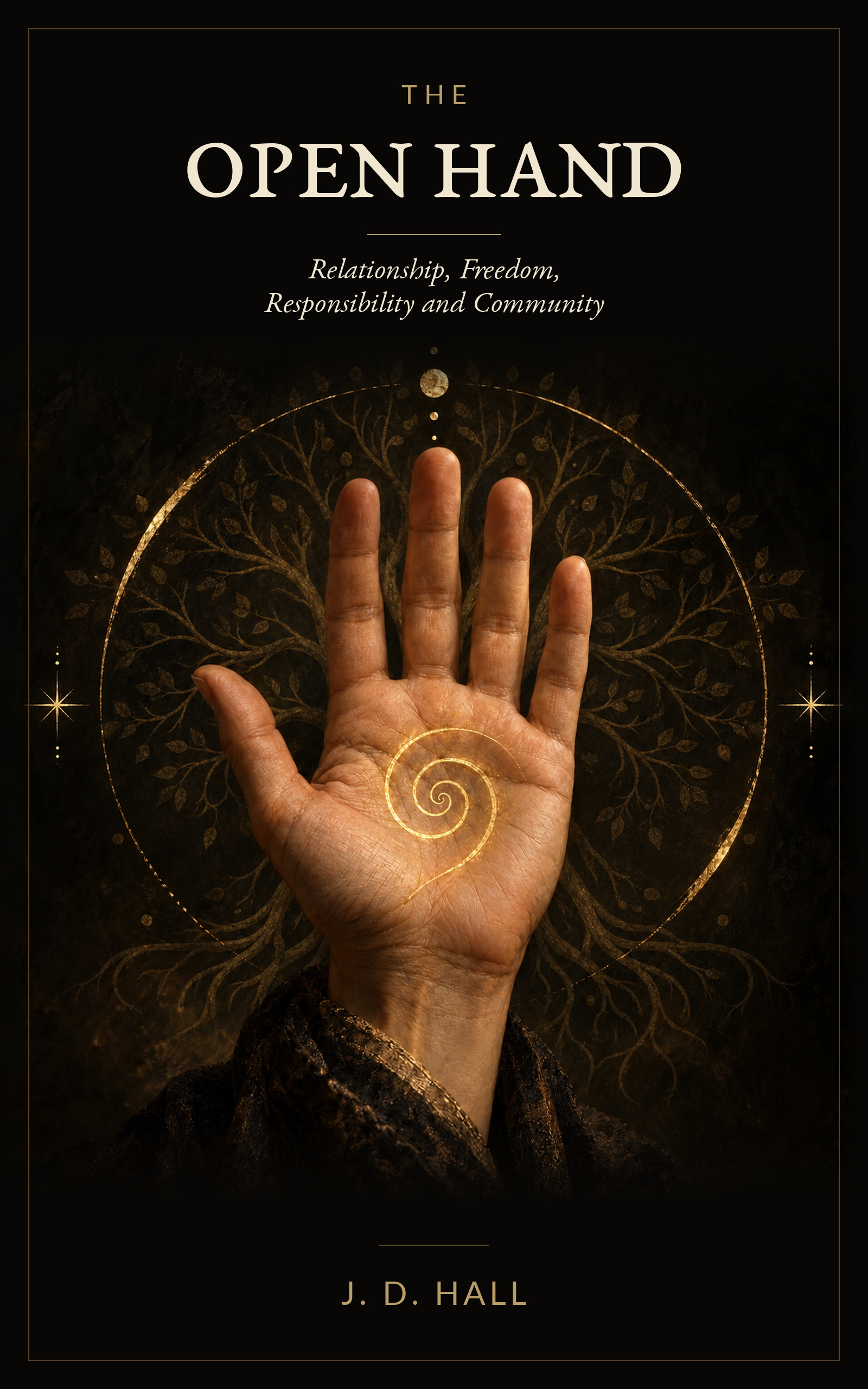
The Open Hand
The hand may close from fear.
Sometimes it must close: to grip a rope, to protect what is fragile, to resist something that would cause harm.
But no hand can remain closed forever without pain.
The open hand is therefore not weakness.
It is readiness.
Ready to receive. Ready to give. Ready to hold. Ready to release. Ready to admit that something once carried may no longer belong within it.
The open hand does not mean having no boundaries. It means refusing to confuse possession with care.
Within the open hand lies possibility.
Around it moves relationship.
And through relationship, everything changes.
Perhaps the deepest practice is simple.
Listen.
Choose.
Allow others to choose.
Notice what your actions enter.
Repair where repair is possible.
Grieve what cannot be restored.
Do not force sameness in the name of harmony.
Do not force stillness in the name of balance.
Do not force obedience in the name of love.
Do not invent certainty merely because uncertainty frightens you.
Hold what you love carefully.
Not weakly. Not carelessly. Carefully.
And when the time comes for something to change, ask whether love requires holding more tightly - or opening the hand.
34
Nothing Breathes Alone
No life begins alone.
No life continues alone.
The breath entering the body has travelled through a world of other lives. The food becoming flesh was once soil, rain, seed, leaf, creature or labour. Language existed before any one speaker learned it. Memory reaches us through people we did not meet.
Even solitude is possible only because a world remains around the solitary person.
This does not mean individuality is an illusion.
The opposite is true.
Relationship has meaning because individuals are real.
Connection does not erase the self. It places the self within consequence, belonging and possibility.
Nothing breathes alone.
Nothing changes alone.
Nothing suffers alone, even when suffering feels solitary, because pain enters relationships through absence, silence, behaviour and need.
Nothing heals alone, because healing draws upon body, time, memory, environment, knowledge, care and choice.
Every life enters the relationships around it.
Every choice alters what becomes possible.
Every act of attention changes what can be heard.
And every open hand makes room for something that did not exist before.
That is enough to begin.
And when beginning is required again, it is enough to begin again.
35
Beginning Again
Beginning again is not returning to the place before failure.
That place no longer exists. Knowledge has entered. Consequence has entered. Grief, responsibility and possibility have changed the ground.
To begin again is to start from what is now true.
Sometimes beginning again means reconciliation. Sometimes it means building a life beyond a relationship that cannot be restored. Sometimes it is a small act: answering a message, opening a curtain, asking for help, admitting what happened without defence.
A new beginning does not make the earlier beginning meaningless.
Nor does it guarantee that the next attempt will succeed.
Hope is present not because the future has promised us anything, but because choice remains capable of entering it.
Carry the lesson without making the wound your identity. Carry memory without demanding repetition. Carry responsibility without believing shame must be permanent.
Open the hand enough to receive what the former self could not yet hold.
Then begin—not as though nothing happened, but because it did.
CLOSING REFLECTION
The Hand Remains Open
No teaching is complete while life continues to change.
The words in this book are not a wall around truth. They are places from which to look.
If they have value, let that value appear in how we listen, how we choose, how we carry power, how we respond to suffering, how we allow others to remain themselves, and how willingly we admit that our understanding is unfinished.
Hold carefully.
Listen deeply.
Choose freely.
Act responsibly.
Repair where repair is possible.
Release what must be released.
Welcome what remains unknown.
When certainty begins to close your hand, open it again.
When fear begins to narrow your world, open it again.
When pride begins to silence listening, open it again.
Wisdom is not the possession of truth.
Wisdom is the willingness to remain in relationship with it.
The hand remains open.
THE COVENANT OF THE OPEN HAND
This covenant is not a test of belonging or a demand for obedience. It is a shared practice: a way of keeping freedom, responsibility and relationship visible when certainty, fear or power begin to close the hand.
We will speak truthfully.
We will listen before judging.
We will allow disagreement without demanding hostility.
We will protect dignity without protecting harm.
We will accept responsibility for consequence.
We will repair where repair is possible.
We will not require another person to surrender conscience in order to belong.
We will remember that freedom and responsibility travel together.
We will leave room for what remains unknown.
When we fail in these practices, we will begin again.
The covenant remains open because no community remains wise when its promises can no longer be questioned.
The hand remains open.
The choice is always yours.
────────